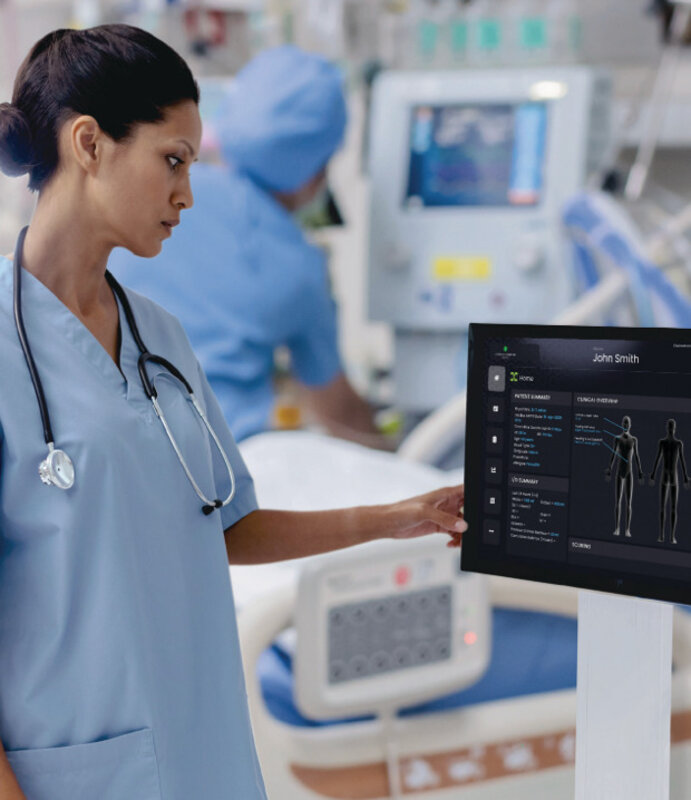
DocBox connects bedside devices, clinical documentation, Virtual Care, and hospital-owned data into one live patient model — giving clinicians, hospitals, and AI systems the real-time context they need. From one bed to your entire hospital, one hospital to your entire network.
ICUs produce hundreds of parameters per patient — physiologic signals, ventilator parameters, infusion rates, monitor trends, assessment notes. Each system captures its slice and holds onto it. By the time the data could improve workflow at the bedside or feed a quality measure, it's trapped in places that don't talk to each other — too late, too fragmented, or too far from where it's needed. DocBox captures, organizes, and operationalizes that data directly from the bedside — so the care team, the operating environment, and the enterprise are working from the same picture, at the same moment.
The data comes in directly from the equipment into the record — without anyone typing it in. Vital signs, ventilator settings, infusion rates, all captured continuously and accurately.
Observations, assessments, and care plan entries that fit the workflow, not the clinic encounter. Designed by and for critical care nurses who know what matters at the bedside.
A nursing record that reflects what actually happened — live device data plus validated assessments — creating a complete historical picture for quality, compliance, charge capture, and continuity.
DocBox returns your nurses to what they do best: clinical care. Not documentation workarounds.
DocBox provides the operational and data foundation required for scalable, clinically relevant, real-time healthcare AI — captured at the bedside, organized as it's captured, ready when it's needed.
DocBox is designed to support clinician-led AI, not replace clinical judgment. Every clinical decision remains with the care team.
Device data captured directly and continuously from the bedside — not periodic samples reconstructed after the fact, but the underlying signal AI models need to be trained, validated, and trusted on.
Information is organized and related as it's entered, so the picture stays coherent as the patient moves through the hospital — and any AI built on top of it has a defensible clinical foundation to run on.
Gigabytes of patient data per bed, per day — owned by the hospital, available for surveillance, quality programs, decision support, and the AI capabilities the health system builds next. No vendor lock-in. No parallel infrastructure required.
The next generation of clinical AI will not run on retrospective records. It will run on the live signal of what's actually happening at the bedside — the foundation DocBox builds.
DocBox creates a connected operational layer between clinicians, patients, devices, and enterprise systems. The same live data informs the bedside workflow, the unit dashboard, the network command center, and the downstream systems that run the hospital.
Physicians and nurses see what's actually happening — device data, assessment notes, lab results, imaging — together, in real time, on one screen. No tab-switching to assemble the picture. No waiting for the chart to catch up. The patient as the data describes them, available the moment a decision needs to be made.
Device data, automatic. The numbers come in directly from the equipment, into the record, without anyone typing them in. Nursing assessment, made easy. Forms designed around the ICU bedside — observations, assessments, and care plan entries that fit the workflow, not the clinic encounter. The result: a nursing record that reflects what actually happened, and hours back for the patient.
DocBox Virtual Care extends the same live patient model to remote intensivists — multi-site coverage, network-wide visibility, and bidirectional remote documentation. Rural and community sites get the same level of oversight as the flagship ICU. The data layer is shared; the workflow is local.
Most quality programs are built on what gets documented. DocBox is built on what actually happens — continuously captured, completely, at the granularity quality work actually needs. The difference shows up everywhere quality matters: in the care delivered at the bedside, in the measures that determine reimbursement, and in the programs that close the loop.
Complete patient context — physiology, trends, and clinical assessment together — available the moment it's needed. The care team makes more consistent decisions because they are working from the same complete picture.
Continuous capture means quality measures and bundle compliance reflect what actually happened at the bedside — not what was charted retrospectively. Programs run on real signal, not after-the-fact reconstruction.
The same record that supports care also feeds quality programs, regulatory reporting, and reimbursement workflows directly — defensible at the source. Less manual chart abstraction. Faster turnaround. Programs run on the real signal, not after-the-fact reconstruction.
DocBox is vendor-neutral by design. It integrates across existing hospital infrastructure, devices, workflows, and enterprise systems — open standards, no proprietary lock-in, no rip-and-replace. The systems already in place keep doing what they do well.
DocBox runs alongside the EHR your hospital already uses, sharing context through open standards. The EHR keeps doing what it was designed to do — clinical record-keeping, billing, compliance. DocBox handles what the EHR was never built for: continuous, real-time data at the bedside.
DocBox is designed to deploy without adding intermediate servers or duplicating what the hospital already runs. Existing connectivity stays in place. The data flows into the same connected stream — wherever it's already coming from.
Monitors, ventilators, and infusion pumps — alongside specialized bedside therapy and monitoring devices like ECMO, CRRT, and IABP. All integrated through the same connectivity layer, into the same patient record.
No rip-and-replace. No parallel systems. See the full connectivity model →
DocBox reduces fragmentation, improves visibility, supports clinicians, and enables more intelligent healthcare workflows at scale. Two products, packaged from one connected data foundation — both running on the same live patient model.
Continuous device capture, structured nursing input, and a unified record on one screen — for the physicians and nurses at the patient's side.
A command center that extends the same live patient model to remote intensivists — multi-site coverage, network-wide visibility, and bidirectional remote documentation.
One bed to your entire hospital. One hospital to your entire network. Compare both products →
DocBox connects the same live patient model to every leader responsible for the ICU — so each team sees the value from where they sit, on one connected foundation.
Reduce documentation burden, return more nurse time to the bedside, and support more complete clinical workflows — with device data captured directly instead of transcribed by hand.
Bring bedside devices, documentation, labs, imaging, and remote care teams into one live patient picture — at the bedside, across the unit, and into the command center.
DocBox integrates across your existing hospital infrastructure, devices, workflows, and enterprise systems — open standards, no proprietary lock-in, no rip-and-replace. Connect vendor-neutral bedside data while maintaining hospital data ownership, open-standards interoperability, and full integration flexibility with what you already run.
Improve documentation completeness, support defensible charge capture, and expand Virtual Care coverage across your network — with operational impact you can measure.
"Our physicians and nurses can monitor all data about the patient on the DocBox screen — X-rays, CT scans, labs, ventilator settings, hemodynamic status. DocBox is a very useful clinical care assistant to the critical care physicians and to the hospital."
Yatin Mehta, MD
Chairman of Critical Care & Anesthesiology
Medanta Hospital, Gurugram, India
Additional hospital outcomes and case studies available during your 30-minute ICU Fit Assessment.
Refined by the clinicians and healthcare technology leaders using it. Read the DocBox story →